By SK Saxena | Techpostsk.com | Quality & QA/QC
Quick Summary: This checklist covers mandatory inspection points before, during & after RCC pour. Use it as your Okey Card / IR to ensure surface prep, water stops, reinforcement, formwork, equipment, placement & curing are 100% compliant with IS 456 and project specs. Avoid honeycombing, cold joints & dimensional errors.
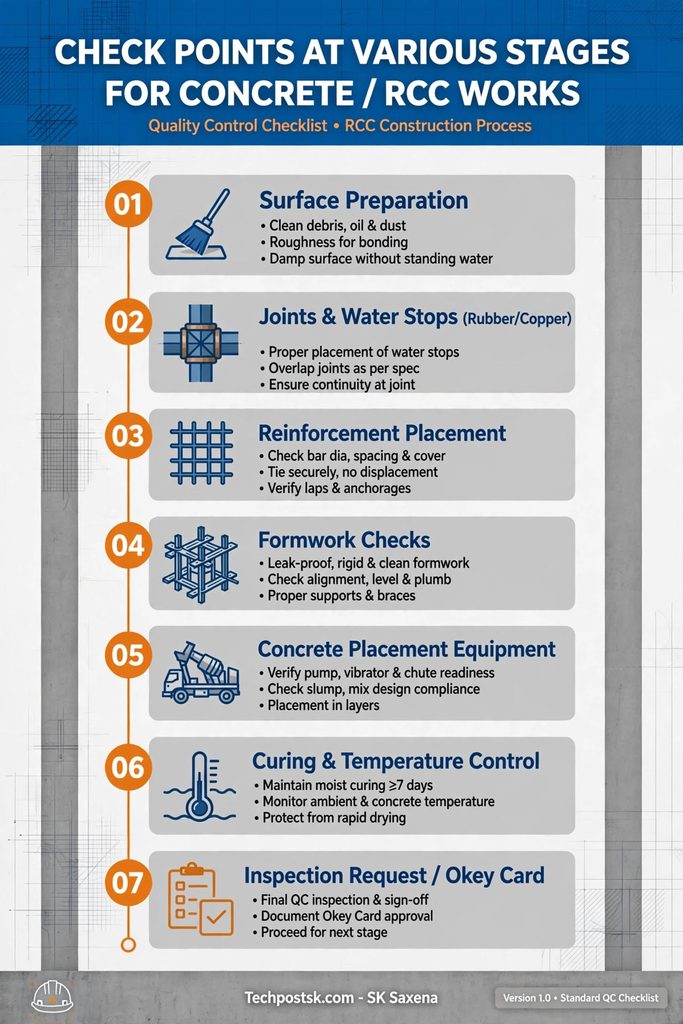
Infographic: Checkpoints at Various Stages for Concrete / RCC Works – Techpostsk.com Table of Contents
Surface Preparation Joints & Water Stops Reinforcement Check Formwork & Shuttering Equipment & Readiness Placement & Curing Okey Card / IR Format
1. Surface Preparation
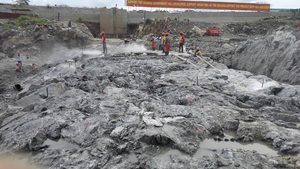
Previous layer surface hacked/roughened & cleaned with wire brush and compressed air
No loose concrete, laitance, dust, oil, or standing water at joint
Construction joint made vertical with stop end & green cutting if required
Bonding agent/cement slurry applied as per spec before fresh pour
Sub-grade / PCC checked for level and compacted
2. Joints & Water Stops
Construction & expansion joint locations as per GFC drawing – approved by consultant
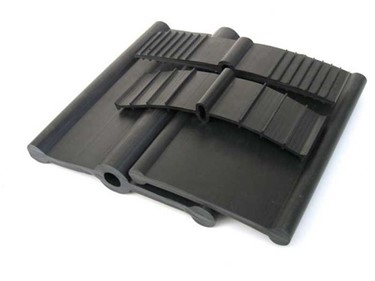
Water stop centered in joint – 50% embedment each side, no nail punctures
Water stop jointing by hot vulcanizing – checked for leaks
Kicker height 75- 150 mm for walls – leak-proof
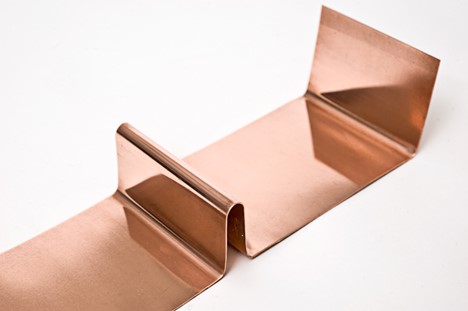
Rubber vs Copper Water Stop Comparison
Parameter Rubber (PVC) Water Stop Copper Water Stop Material & Flexibility High elasticity, accommodates large movement Rigid, limited movement Best Use Expansion joints, water-retaining structures Construction joints, dams Durability Good, but UV sensitive Excellent, 50+ years Cost & Handling Economical, easy to weld Costly, needs skilled brazing
3. Reinforcement
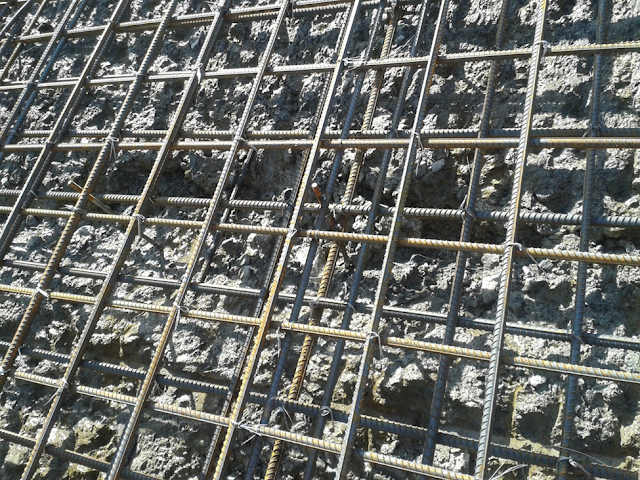
Bar dia, spacing, lap length, anchorage & development length as per BBS & IS 456
Cover: 50mm for raft/walls in contact with earth, 30- 40 mm for beams/slabs – cover blocks PVC/concrete
Chairs at 1m c/c, spacer bars for multi-layer – no sag
Binding wire cut ends turned inside, no loose wires
Stirrups spacing near supports – L/4 densified
4. Formwork & Shuttering
Alignment, plumb, line & level within ±6mm tolerance
Formwork tight, no gaps >2mm – foam seal used at joints
Shuttering oil applied thin & uniformly – no excess
Props braced, sole plates provided, staging stable
Hole for vibrator insertion & pour height marked
Formwork De-shuttering Time as per IS 456:2000
Structural Member Minimum Stripping Time Vertical sides – columns, walls, beam sides 16 to 24 Hours Slabs (props left under) 3 Days Beam soffits (props left under) 7 Days Props to slabs upto 4.5m span 7 Days Props to slabs above 4.5m span 14 Days Props to beams & arches upto 6m 14 Days Props to beams & arches above 6m 21 Days
5. Equipment & Readiness
Batching plant / weigh batcher calibration valid – admixture dispenser checked
Transit mixers, concrete pump & boom placed – pipeline primed with slurry
Needle vibrators 40- 60 mm dia – 2 working + 1 standby, adequate fuel/power
Slump cone, thermometers, cube moulds 150mm – 6 nos per 50 cum
Lighting tower & access for night pour, safety barricade
6. Concrete Placement & Curing
Slump 75- 100 mm for general RCC, 100- 125 mm for pumped concrete – no extra water
Drop height < 1.5 m, layer thickness < 300 mm, continuous pour – avoid cold joints> 30 min
Vibration – insert vertically at 300- 500 mm spacing, avoid touching rebar & formwork
Construction joint at L/3 or as specified – not at max BM
Curing start within 2-4 hrs after initial set – 14 days min by gunny bags/ponding/compound
7. Okey Card / IR Format – Final Inspection
Below is the standard Okey Card format with 19 checkpoints used for QC & Client sign-off before pour permission.
S.No Check Point Status Remarks 1 Surface preparation, cleaning & laitance removal done OK / Not OK 2 Joint location & water stop fixing as per drawing OK / Not OK 3 Reinforcement dia., spacing, lapping & development length OK / Not OK 4 Cover blocks, chairs & spacer bars provided OK / Not OK 5 Formwork line, level, alignment & dimensions OK / Not OK 6 Formwork tightness & shuttering oil application OK / Not OK 7 Embedded parts, inserts & sleeves fixed OK / Not OK 8 Construction joint treatment OK / Not OK 9 Mix design & batching plant calibration OK / Not OK 10 Slump test & cube moulds arrangement OK / Not OK 11 Vibrators & standby equipment availability OK / Not OK 12 Placement sequence, layer thickness & drop height OK / Not OK 13 Compaction, finishing & cold joint prevention OK / Not OK 14 Curing arrangement & duration OK / Not OK 15 Weather protection & ambient temperature OK / Not OK 16 Formwork removal time compliance OK / Not OK 17 Honeycombing & surface defects check OK / Not OK 18 Dimensional tolerance after de-shuttering OK / Not OK 19 Documentation & IR sign-off OK / Not OK